ENTREPRENEURSHIP IN THE INFORMAL SECTOR DURING TRANSITION: CAUSES, SPECIFIC FEATURES, SOCIO-ECONOMIC EFFECTS
A. Chepurenko,
J. Round
National Research University Higher School of Economics
Introduction
While there is a relative lack of discussion on the specifics of entrepreneurship in transitional economies there is a broad agreement that the level and forms of activity is lower than in more developed economies and that the sector's growth rate has been disappointing (see for example: [Thurik, 2009; Stam, Stel, 2009; Aidis et al., 2010; Mickiewicz, Estrin, 2011]).
However, and of crucial importance to this paper, there are wide varieties in the form and scale of entrepreneurship within the group of transitional states even after twenty years since the collapse of the Soviet Union and the subsequent economic reforms [Chepurenko, 2011]. Using GEM data and interviews with small scale entrepreneurs in Moscow this paper begins to explore such issues and is structured as follows; firstly it details and explains the differences between entrepreneurship levels and forms between transition countries, also making comparisons to other efficiency-driven economies, before highlighting some of the specific issues that this sector in Russia faces. The paper concludes by positing some brief discussions on the socio-economic impacts arising from the forms that Russian entrepreneurship has taken.The intensity and structure of entrepreneurial activity in transitional countries: GEM 2011 evidence
The initial hopes that the emergence of a market economy would see a rapid increase in entrepreneurial activity and enhance the possibilities for innovative new
ventures were not realized in most transitional countries [Mickiewicz, Estrin, 2011]. After a significant but short entrepreneurial boom at the start of the transition period in most post-socialist states the dynamics of entrepreneurship development declined. Some smaller Eastern European countries show a density of entrepreneurship comparable with more mature European economics but most of the bigger CIS economies are characterized by very low levels of entrepreneurship and a very small portion of the entrepreneurial firms are really engaged in high-tech innovative ventures (for further discussion see [Obraztsova, Chepurenko, 2010]).
Given that the transition countries have different levels of market memory (see [Round, 2009]) and different levels of integration into the Soviet command economy [Mickiewicz, Estrin, 2011] it is no surprise that entrepreneurship has taken different forms across the transition region. Further compounding these legacies the market reform prescriptions ignored these different economic geographies and a «one size fits» all transition policy was introduced [Round, 2009]. However, while formal institutions can be formed rapidly the informal structures that surround them can take far longer to reform [Stiglitz, Meier, 2001]. As data from the World Economic Forum (2012), EBRD (2011), Transparency International (2011) and the World Bank's «Ease of Doing Business» report (2011) demonstrate, few, if any, transition countries have succeeded in reforming all the sectors needed to foster high levels of entrepreneurship. Thus as the below discussions show the outcomes of this are low levels of entrepreneurship, especially in the innovative sector, across the region and especially in Russia.It is evident that the most sources of official statistics may hardly be used to make estimations of numerical data concerning the informal entrepreneurship. Moreover, there are no reliable alternative sources which could enable any cross-country comparison of this sector. The most relevant and reliable source to compare entrepreneurial activity of physical persons across countries, Global Entrepreneurship Monitor, exploring the entrepreneurial engagement of the adult population in several countries of the world since the late 1990ies, enables an access to the unique database to estimate the share of population engaged in any forms of entrepreneurial activity or quitting a business. Despite this it does not focus on questions of formality/ informality, basing on this data at least very general estimations of the total entrepreneurial activity, motivation structure and human and social capital assets of entrepreneurs.
First, on the base of the GEM[LXXVIII] data, it is possible to confirm that in most of the transitional countries the entrepreneurial engagement of adults is rather modera
te or even low on each stage of entrepreneurial activity (Table 1). Meanwhile, some authors insist on the thesis that informal entrepreneurship in transitional countries may rely on the fact that many adults during the systemic transition were been pushed into entrepreneurship. This thesis finds support only for some of them (Bosnia and Herzegovina, China), whereas in other transitional countries the necessity entrepreneurship in general does not exceed the average numbers for respective croups of countries.
Table 1. Entrepreneurial activity in 54 economies
by phase of economic development, 2011
| Nascent entrepreneurship rate | New business ownership rate | Early-stage entrepreneurial activity (TEA) | Established business ownership rate | Discontinuation of businesses | Necessity- driven (% of TEA) | Improvement- driven opportunity (% of TEA) | |
| Factor-driven economies | |||||||
| Algeria | 5,3 | 4,0 | 9,3 | 3,1 | 9,5 | 37 | 46 |
| Bangladesh | 7,1 | 7,1 | 12,8 | 11,6 | 2,5 | 27 | 50 |
| Guatemala | 11,8 | 9,1 | 19,3 | 2,5 | 3,8 | 33 | 33 |
| Iran | 10,8 | 3,9 | 14,5 | 11,2 | 6,4 | 53 | 32 |
| Jamaica | 9,0 | 5,0 | 13,7 | 5,1 | 12,7 | 33 | 40 |
| Pakistan | 7,5 | 1,7 | 9,1 | 4,1 | 1,6 | 47 | 25 |
| Venezuela | 13,1 | 2,6 | 15,4 | 1,6 | 3,2 | 29 | 43 |
| average (unweighted) | 9,2 | 4,8 | 13,4 | 5,6 | 5,7 | 37 | 38 |
| Efficiency-driven economies | |||||||
| Argentina | 11,8 | 9,2 | 20,8 | 11,8 | 4,3 | 33 | 45 |
| Barbados | 10,8 | 1,8 | 12,6 | 4,2 | 5,5 | 5 | 58 |
| Bosnia and Herzegovina | 5,4 | 2,8 | 8,1 | 5,0 | 6,7 | 61 | 22 |
| Nascent entrepreneurship rate | New business ownership rate | Early-stage entrepreneurial activity (TEA) | Established business ownership rate | Discontinuation of businesses | Necessity- driven (% of TEA) | Improvement- driven opportunity (% of TEA) | |
| Brazil | 4,1 | 11,0 | 14,9 | 12,2 | 3,8 | 31 | 45 |
| Chile | 14,6 | 9,6 | 23,7 | 7,0 | 6,8 | 27 | 54 |
| China | 10,1 | 14,2 | 24,0 | 12,7 | 5,3 | 41 | 29 |
| Colombia | 15,2 | 6,7 | 21,4 | 7,5 | 6,0 | 25 | 30 |
| Croatia | 5,3 | 2,1 | 7,3 | 4,2 | 3,6 | 35 | 31 |
| Hungary | 4,8 | 1,6 | 6,3 | 2,0 | 2,3 | 31 | 29 |
| Latvia | 6,8 | 5,3 | 11,9 | 5,7 | 3,0 | 26 | 46 |
| Lithuania | 6,4 | 5,0 | 11,3 | 6,3 | 2,9 | 28 | 47 |
| Malaysia | 2,5 | 2,5 | 4,9 | 5,2 | 2,6 | 10 | 72 |
| Mexico | 5,7 | 4,0 | 9,6 | 3,0 | 5,0 | 19 | 55 |
| Panama | 12,0 | 9,1 | 20,8 | 6,0 | 2,1 | 27 | 40 |
| Peru | 17,9 | 5,4 | 22,9 | 5,7 | 5,1 | 22 | 52 |
| Poland | 6,0 | 3,1 | 9,0 | 5,0 | 4,2 | 48 | 32 |
| Romania | 5,6 | 4,5 | 9,9 | 4,6 | 3,9 | 41 | 34 |
| Russia | 2,4 | 2,3 | 4,6 | 2,8 | 1,5 | 27 | 42 |
| Slovakia | 9,2 | 5,3 | 14,2 | 9,6 | 7,0 | 28 | 34 |
| South Africa | 5,2 | 4,0 | 9,1 | 2,3 | 5,6 | 35 | 39 |
| Thailand | 8,3 | 12,2 | 19,5 | 30,1 | 4,5 | 19 | 67 |
| Trinidad & Tobago | 13,9 | 9,3 | 22,7 | 6,9 | 3,9 | 15 | 44 |
| Turkey | 6,3 | 6,0 | 11,9 | 8,0 | 3,9 | 32 | 45 |
| Uruguay | 11,0 | 6,0 | 16,7 | 5,9 | 4,3 | 11 | 10 |
| average (unweighted) | 8,4 | 5,9 | 14,1 | 7,2 | 4,3 | 28 | 42 |
| Innovation- driven economies | |||||||
| Australia | 6,0 | 4,7 | 10,5 | 9,1 | 4,3 | 15 | 73 |
| Belgium | 2,7 | 3,0 | 5,7 | 6,8 | 1,4 | 10 | 72 |
| Czech Republic | 5,1 | 2,7 | 7,6 | 5,2 | 2,7 | 27 | 57 |
| Nascent entrepreneurship rate | New business ownership rate | Early-stage entrepreneurial activity (TEA) | Established business ownership rate | Discontinuation of businesses | Necessity- driven (% of TEA) | Improvement- driven opportunity (% of TEA) | |
| Denmark | 3,1 | 1,6 | 4,6 | 4,9 | 2,3 | 7 | 64 |
| Finland | 3,0 | 3,3 | 6,3 | 8,8 | 2,0 | 18 | 59 |
| France | 4,1 | 1,7 | 5,7 | 2,4 | 2,2 | 15 | 71 |
| Germany | 3,4 | 2,4 | 5,6 | 5,6 | 1,8 | 19 | 55 |
| Greece | 4,4 | 3,7 | 8,0 | 15,8 | 3,0 | 25 | 37 |
| Ireland | 4,3 | 3,1 | 7,2 | 8,0 | 3,4 | 29 | 37 |
| Japan | 3,3 | 2,0 | 5,2 | 8,3 | 0,7 | 25 | 64 |
| Korea Rep. | 2,9 | 5,1 | 7,8 | 10,9 | 3,2 | 41 | 36 |
| Netherlands | 4,3 | 4,1 | 8,2 | 8,7 | 2,0 | 9 | 62 |
| Norway | 3,7 | 3,3 | 6,9 | 6,6 | 2,5 | 4 | 70 |
| Portugal | 4,6 | 3,0 | 7,5 | 5,7 | 2,9 | 18 | 58 |
| Singapore | 3,8 | 2,8 | 6,6 | 3,3 | 2,1 | 16 | 53 |
| Slovenia | 1,9 | 1,7 | 3,7 | 4,8 | 1,5 | 12 | 51 |
| Spain | 3,3 | 2,5 | 5,8 | 8,9 | 2,2 | 26 | 39 |
| Sweden | 3,5 | 2,3 | 5,8 | 7,0 | 3,2 | 6 | 68 |
| Switzerland | 3,7 | 2,9 | 6,6 | 10,1 | 2,9 | 11 | 61 |
| Taiwan | 3,6 | 4,4 | 7,9 | 6,3 | 4,9 | 17 | 50 |
| United Arab Emirates | 3,7 | 2,6 | 6,2 | 2,7 | 4,8 | 14 | 67 |
| United Kingdom | 4,7 | 2,6 | 7,3 | 7,2 | 2,0 | 17 | 46 |
| United States | 8,3 | 4,3 | 12,3 | 9,1 | 4,4 | 21 | 59 |
| average (unweighted) | 4,0 | 3,0 | 6,9 | 7,2 | 2,7 | 18 | 57 |
Source: GEM 2011 Adult Population Survey.
Belonging to two different groups of countries, efficiency-driven and innovation-driven, most of them belong to those with the lowest level of entrepreneurial activity (TEA level, in terms of the Global Entrepreneurship Monitor - see Fig.
1). Thus, also the informal entrepreneurship, forming a part of the TEA according to the GEM methodic, is forming a rather small group.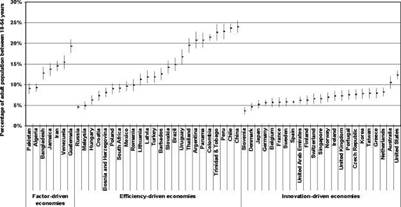
Note: GEM groups the participating economies into three levels: factor-driven, efficiency-driven, and innovation-driven. These are based on the World Economic Forum’s (WEF) Global Competitiveness Report, which identifies three phases of economic development based on GDP per capita and the share of exports comprising primary goods.
Fig. 1. Total early-stage entrepreneurial activity (TEA) in 54 economies, by phase of economic development, 2011
Source: GEM 2011 Adult Population Survey.
If we take the above GEM data for the transitional countries, we can conclude that in general:
• the level of early entrepreneurial activity is relatively low, below the average (with a few exceptions);
• the level of perceived opportunities and perceived capabilities to start-up is as a rule lower, whilst the level of fear of failure - higher than in the respective group of established market economies;
• the share of necessity-driven entrepreneurs who might be the «natural» body of informal entrepreneurship - is hardly higher than among all countries belonging to each respective group (efficiency or innovation driven).
Why are entrepreneurship levels so low and informality so high in transitional economies (the example of Russia)?
Another specific feature of entrepreneurial activity in transitional countries is the informal character not only of start-ups but even of many already well estab-
lished businesses (see [Williams, 2010; Williams, Round, 2010] for further discussion). Gimpelson and Zudina (2011) have shown that in Russia employment within informal economies is growing at a faster rate than economic grown and than the incremental dynamics of jobs in formal economic activity. They argue that most of such people operating informally are sole proprietors or self employed in different sectors. There are numerous reasons for choosing informal entrepreneurial activity according to the mainstream literature (see [Williams, 2005, 2008; Marcelli et al., 2010]). Firstly, a lack of resources and credibility pushes some entrepreneurs into the shadow economy where only informal activities are possible. Secondly, levels of state regulation and administrative burdens may lead to the same result. Thirdly, there are some «avoidable markets» where informal activity only is possible and fourthly, some freelance activities can be started only as a second job realized on informal manner. In some weaker transitional economies, there are some additional reasons which lead to the growing number of business deals done informally.
As the above discussions have shown almost all of the indicators on entrepreneurship in Russia are worse than in other transition countries and rates of informality are very high. The WEF report places Russia's institutions, when related to com- petiveness, at 128th in the world out of 142 countries. Within this one of the main issues is the lack of juridical security which impacts negatively on property rights [Nystrom, 2008; Acs et al., 2008]. As Aidis et. al. (2010, p. 21) state:
The strong protection of property rights plays a pivotal role in the institutional environment. This is a single dimension, which dominates all other institutional variables when we compress the data into a smaller number of dimensions using factor analysis...
Interviewees we asked in different Russian regions in 2007-2008 on entrepreneurship conditions bringing them to informality discussed how it is extremely hard to get credit to start, and/or expand, a business and there is little culture of lending to nascent entrepreneurs. Further to this Russia suffers from an overly bureaucratic system with regards to the regulation of enterprises, as one interviewee said:
I have never thought about getting a license because it is a very complicated bureaucratic process. I just do not have time and the nerve to stand in lines for days and weeks. It is amazing; if the state wants taxes why does it not organize things so that all the procedures to get a license go quickly and without bribes? I have the impression that if a person wants to pay taxes out of his/her off-the-books income in this country, they have to be obsessed by this idea and fight for their rights to do it with the state itself.
All in all, for the nascent entrepreneur there is little advantage in trying to become formal quickly given the paperwork and time involved. Exacerbating the amount of paperwork needed to start a business is the informal payments that are
often needed to be paid to state actors in order to get it completed. As an interviewee who is now operating wholly informally said:
I wanted to try and start a formal business but I was asked to pay so many bribes and in the end I just gave up. If there are so many payments to be made in just setting up a business how many would I have to pay in the future...
As cultures of informality become embedded then they begin to have a causal effect as people assume that they will have to make informal payments and therefore do not even try to engage with formal state organisations [Round et al., 2010]. The fact that so many other areas of everyday life in Russia are infused with informal practices also reinforces this cycle. As Williams and Round (2010) note only 10% of their respondents operate wholly in the formal sphere. Many interviewees discussed how even when in formal employment part of their salary is paid informally («in an envelope») and thus a culture of informality across society is reinforced. This is further entrenched by the coping practices many Russian households employ in the face of economic marginalisation with informal exchange, favours, informal secondary employment, inter-generational gifts among the many non-for- mal tactics employed. Therefore, a «circle of informality» can be seen to be in operation, which also includes subsistence economies in villages and small towns and households services provided informally, sees a significant amount of informal incomes which may be realized in buying informally produced and distributed goods.
The low average income of Russian households also stymies formal entrepreneurship development as it reduces the level of economic demand from the population and their ability to pay for services. As the costs of formalisation (through the paying for permits and informal payments) increases the transaction costs then it is in the interest of the entrepreneur to remain informal and at a small scale. There is no point in trying to compete with larger scale firms or with foreign firms because of this, which helps explain why so many Russian enterprises are small scale and involved in the service provision sector.
The lack of effective institutions and rent seeking officials, and the resulting culture of informality, also explains why the perceived opportunities and entrepreneurial intentions are so low in Russia when compared to other transition countries and why the fear of failure is so high.
This is not to say that entrepreneurs do not wish to formalise their operations. The most common problem cited by interviewees was that acting informally made it almost impossible to obtain credit through the banking system. Thus they were often unable to fund expansion or to protect themselves during periods of low incomes. To expand, or to survive, interviewees had to turn to family or social networks but for
the vast majority there was a relatively small limit to what this form of fund raising could achieve. Furthermore, informality does not hide entrepreneurs totally from rent seeking officials and it makes them vulnerable to attack as because they do not pay tax, and are thus operating illegally, they thus do not have legal recourse if they are cheated or payments are not made. As one interviewee discussed:
I just wish things could be more secure. It is so tiring not knowing what the future will bring. If we could formalise like they do in the west it would make everything easier and we could concentrate on running the business rather than worrying about what tomorrow will bring.
Amongst interviewees who were considering starting an enterprise this continual insecurity was the most commonly discussed reason why they were reticent to actually start.
Conclusion
The low levels of entrepreneurial activity in Russia, and the high levels of informality contained within the sector, are resulting from the character of socioeconomic model and have significant implications for the wider society. As Che- purenko (2011) notes entrepreneurialism has positive impacts upon society as it brings dynamism, new approaches and innovations and helps develop societal norms (see also [Bahmani et al., 2012; Di Martino, 2012; Katic et al., 2011] for further discussion).
On a more practical level obviously informality means the Russian state receives a lower tax base than it could otherwise expect. Hence, bribes increase the personal welfare of bureaucrats but diminish the external outcomes of the SME sector for the society as a whole. Moreover, operating informally also dramatically constrains the ability of enterprises to grow as they are unable to obtain credit and are worried about the behaviour of rent seeking officials. They do not provide additional employment opportunities for others and there is little local, regional or national expansion. Furthermore, a certain scale effect occurs: to establish a venture in the formal economy, you might possess over well functioning relations to decisions makers - if nit, you are enforced to start-up in the shadow and remain informally as much as possible. This stymies competition against foreign and large Russian firms which enables monopolistic growth within sectors, reducing competition, further increasing barriers to entry.
That is why - in parallel with recent measures aimed at increasing innovation and entrepreneurship, such as Skolkovo and establishing of development institutions, attention must be paid to smaller service based firms as well.
References
Acs J., Desai S., Hessels J. Entrepreneurship, Economic Development and Institutions // Small Business Economics. 2008. Vol. 31 (3).
Aidis R., Estrin S., Mickiewicz T. Institutions, Finance and the Level of Development: The Impact on Entrepreneurship in Transition // Review of Economics and Institutions. 2010. Vol. 1 (1).
Bahmani S., Galindo M., Mendez M. Non-profit Organizations, Entrepreneurship, Social Capital and Economic Growth // Small Business Economics. 2012. Vol. 38 (3).
Chepurenko A. Entrepreneurship and SME Policies in the 21stCentury - The Example of Russia // Handbook of Research on Entrepreneurship Policies in Central and Eastern Europe / ed. by D. Smallbone, F. Welter. Cheltenham: Edward Elgar, 2011. Р. 190-209.
Di Martino P. Legal Institutions, Social Norms, and Entrepreneurship in Britain // Economic History Review. 2012. Vol. 65 (1).
EBRD. Transition Report 2011: Crisis in Transition: The People's Perspective. (http://www.ebrd.com/pages/research/publications/flagships/transition.shtmllastaccessed28/ 02/12)
Estrin S., Aidis R., Mickiewicz T. Institutions and Entrepreneurship Development in Russia: A Comparative Perspective // Journal of Business Venturing. 2008.
Katic I., Penezic N., Borocki J., Zekic S. Entrepreneurship Significance in Restructuring Process // Technics Technologies Education Management. 2011. Vol. 6 (4).
Marcelli E., Williams C., Joassart P. (eds.) Informal Work in Developed Nations. London: Routledge, 2010.
Mickiewicz T., Estrin S. Entrepreneurship in Transition Economies: The Role of Institutions and Generational Change // Dynamics of Entrepreneurship / ed. by M. Min- niti. Oxford: Oxford University Press, 2011. Р. 181-208.
Nystrom K. The Institutions of Economic Freedom and Entrepreneurship: Evidence from Panel Data // Public Choice. 2008. Vol. 13 (3).
Obraztsova O., Chepurenko A. Entrepreneurship and Socio-economic Development in Cross-Countries Analysis // Strategic Entrepreneurship - The Promise for Future Entrepreneurship, Family Business and SME Research? / Papers presented to the Rencontres de St-Gall 2010 / ed. by U. Fueglistaller, T. Volery, W. Weber. St. Gallen: KMU-Verlag, 2010.
Round J. Transitional Economies // Kitchin R., Thrift N. (eds.) International Encyclopaedia of Human Geography. Oxford: Elsevier, 2009. Р. 355-360.
Round J., Williams C., Rodgers P. The Role of Domestic Food Production in Everyday Life in Post-Soviet Ukraine // Annals of the Association of American Geographers. 2010. Vol. 100 (5).
Stam Erik, Stel A. van. Types of Entrepreneurship and Economic Growth: UNU- MERIT Working Paper Series 049, United Nations University, Maastricht Economic and Social Research and Training Centre on Innovation and Technology. 2009.
Stiglitz J., Meier G. Frontiers of Development Economics: The Future in Perspective. World Bank; Oxford University Press USA, 2001.
Thurik R. Entrepreneurship, Economic Growth and Policy in Emerging Economies: UNU-WIDEr Research Paper № 2009/12. 2009.
Transparency International. Corruption Perceptions Index 2011. (http://cpi.transparency.org/cpi2011/ last accessed 28/02/12)
Williams C.A. Commodified World? Mapping the Limits of Capitalism. London: Zed Books, 2005.
Williams C. The Hidden Enterprise Culture. Cheltenham (paperback): Edward Elgar, 2008.
Williams C. Re-thinking the Penetration of Capitalism in the Commonwealth of Independent States // Foresight. 2010. Vol. 12 (1).
Williams C., Round J. The Shallow and Uneven Diffusion of Capitalism in Everyday Life in Post-Soviet Moscow // Debatte: Journal of Contemporary Central and Eastern Europe. 2010. Vol. 18.
World Economic Forum (2012) The Global Competitiveness Report 2010-2011. (http://www.weforum.org/reports last accessed 28/02/12)
Гимпельсон В., Зудина А. «Неформалы» в российской экономике: сколько их и кто они? // Вопросы экономики. 2011. № 10. С. 53-76.
Еще по теме ENTREPRENEURSHIP IN THE INFORMAL SECTOR DURING TRANSITION: CAUSES, SPECIFIC FEATURES, SOCIO-ECONOMIC EFFECTS:
- RESUME 4 «The European region: features of economic models of the countries of the Europe and EU»
- RESUME 4 «The European region: features of economic models of the countries of the Europe and EU»
- Public sector borrowing requirement (PSBR)
- RESUME 2 «The international division of labour as a material basis of development of economic»
- RESUME 2 «The international division of labour as a material basis of development of economic»
- Библиография
- Библиография
- НЕКОТОРЫЕ УГОЛОВНО-ПРАВОВЫЕ ПРОБЛЕМЫ ПЕРИОДА ГЛОБАЛИЗАЦИИ В РОССИИ Л. А. Андреева Филиал Российского государственного гуманитарного университета, г. Великий Новгород, Россия
- Литература
- RESUME 1 «World Economy And Its Structure»
- RESUME 1 «World Economy And Its Structure»
- Литератур