ON EDGEWORTH CONJECTURE AND CONTRACTUAL ECONOMIES WITH PUBLIC GOODS[4]
V.M. Marakulin
Sobolev Institute of Mathematics, Russian Academy of Sciences
The paper applies and elaborates contractual approach to study economies with a production of public goods.
The barter contractual approach was developed in [Ma- rakulin, 2003, 2011] for exchange economies; it is now modified and extended to the production economy. This includes hereby the introduction of production contract and the adoption of known earlier notions, they are: a web of contracts, coalitional domination for webs, a partial breaking of contracts and so on. Thus specific notion of fuzzy contractual allocations for economy with public goods is introduced and its equivalence with Lindahl equilibrium is stated. This theorem can be interpreted as a new way of perfect competition presentation.Introduction
Modern views on the theory of financing of public goods stem from Samuelson's papers and results of some other authors, see survey [Milleron, 1972] and monograph [Ruys, 1974]. A public good is a product of joint consumption of all economic agents. The Pareto efficient mechanism of public goods reproduction is based on the individual valuations calculated as a product of the individual price and total consumption. An appropriate theoretical concept of Pareto efficient equilibrium defined in the literature is known as Lindahl equilibrium. However practical implementation of the individual prices apparatus being applied to public goods raises a problem of these prices (and taxes) calculation. This is in fact a difficult theoretical question that still does not have a clear answer in the classical theory. One way to solve this problem could be based on the cooperative description of equilibrium, in such a way as it is done in models with purely private goods, via a theorem on the coinci
dence of core and equilibrium under perfect competition conditions.
However, exam2
ples show that under ordinary replication of an economy the Foley core does not shrinks to equilibrium (see [Muench, 1972; Milleron, 1972]). The problem finds its resolution in the modern literature only through the transformation of the concept of coalitional domination. Instead of the familiar public goods so-called semi-public goods are introduced, as it was done in [Vasil'ev et al., 1995] (see also [Weber, Wismeth, 1991]). The difference is that now the utility of consumed goods depends of the total number of its customers[5][6]. One can say that consumers are interested in the average level of consumption of public goods. In theory such concepts as «returns to group size» are appeared, see [Roberts, 1974], a congestion of good etc. Vasil'ev et al. (1995) proved subtle theorems on the coincidence of the core and equilibria under assumption of constant returns to the size of the coalition. In this paper the theorem on the coincidence of the core and Lindahl equilibrium is stated within the contractual approach and under assumptions that are similar those made in the mentioned papers. However, here we are not talking about coalition sizes or a measure of congestion in public goods: in the model individuals are engaged in ordinary economic activity, they sign and break (partially and asymmetrically) production and barter contracts, thereby producing a stable regime of functioning, which corresponds to a Lindahl equilibrium allocation.
The analysis is based on the author's approach developed in the series of papers of the recent decade in the context of exchange economies of various kinds and generality. The idea of the barter exchange (contract) is by no means new in theoretical economics and evidently goes back to classical Edgeworth results (1881), but it usually appeared as an interpretation, in the form of net trade in a formal model. Contract as a barter exchange of commodities appears in the works of other authors (though the theory of barter contracts was not elaborated in a proper way), including Russian ones: Polterovich (1970) and Makarov (1982).
Then Kozyrev (1981) suggested partial breaking of contracts and obtained some preliminary positive results. Incorporation of partially breaking contracts into the notion of stable webs provides an alternative description of Walrasian equilibrium for the case of complete markets. The author's results [Marakulin, 2003, 2011] provide a basis of barter contract theory that can be considered as a cooperative replenishment of the classical views on the condition of perfect competition in market economy.
In the consumption sector every contract is an elementary permissible exchange of commodities among consumers (barter): the members of a coalition implement the exchange of commodities. Contracts may be summed up and an allocation of resources may be put into correspondence to every (finite) set of contracts - as a result of summation of contracts and the initial endowments allocation. The presence of production affects contract definition in an essential way: it describes an allocation of individual inputs to a production plan. It is presumed that every feasible set of (permissible) contracts - let us call it a «web of contracts»- may be changed during periods of economic activity. Each consumer or a coalition of consumers can break contracts in which he/she participates, and a coalition can also sign a new one. Sometimes the partial break of contracts is also permissible. Our theory examines stable web of contracts where stability can take various forms depending on admissible ways of contract breaking: total, partial (symmetric break), fuzzy (partial asymmetric break), etc. A peculiar property of our contractual approach is that all production and exchange processes operate without any kind of value parameters.
So, the paper presents a contractual analysis of equilibria for production economies with public goods. The specific notion of fuzzy contractual allocation is introduced and studied. The main theorem states an equivalence of Lindahl equilibrium and fuzzy contractual allocations (convex production with constant returns to scale): this is significant result of the paper, correctly introducing perfect competition into public goods economics.
Public goods economy and Lindahl equilibrium
An economy with public goods is specified by the presence of special commodities, which by their physical characteristics are the goods of public consumption. Formally public good is a commodity that is simultaneously consumed by many agents; and there is a need to reproduce it that has to be somehow financed. It is clear that the funding of production of collective consumption commodity should be carried out by all its consumers. In the neoclassical theory of decentralized economy the concept of individual valuations is considered as a basis for the public goods financing, these valuations are calculated as the product of individual prices and a (total) consumption bundle. In theory, an appropriate concept of equilibrium (by Lindahl) is defined and studied in such a way that the related allocation is Pareto optimal one. It is a difficult theoretical problem of correct determination of individual prices in practice. Really, in the case of private commodities this issue is resolved via the
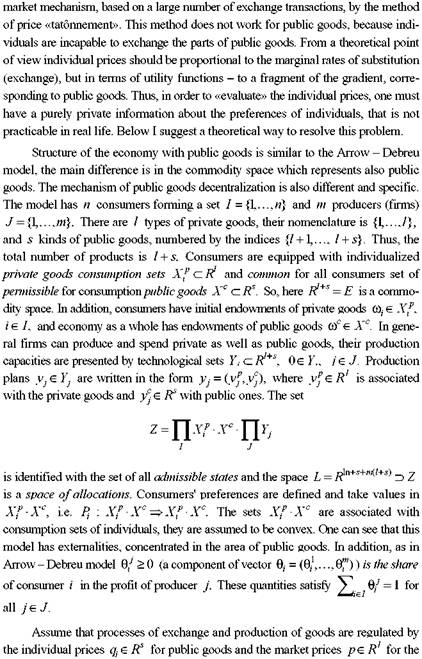
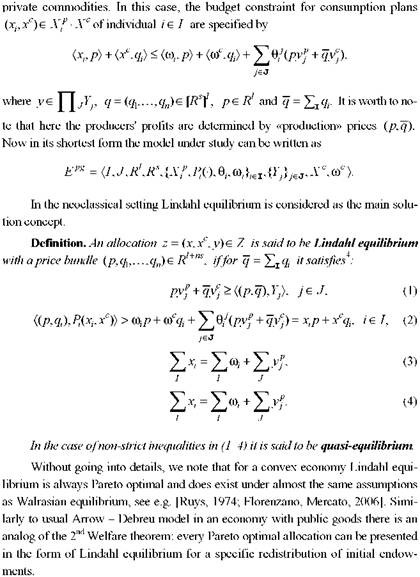

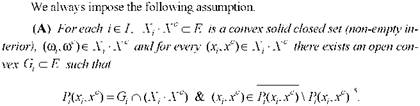
We shall also apply a specific notion of locally non-satiated preferences of each individual in the groups of private and (separately) public goods. The latter means that changing of consumption bundle (xp,xci) only in part of private or (separately) public goods while the consumption from another group of commodities is the same, it is possible to obtain strictly preferred consumption bundle:

In the model Epg with public goods the concept of Foley core is usually considered in the literature and it has a familiar substantial sense: the set of all production allocations, which can be dominated by no coalition, i.e., no group of individuals would benefit to live as a separate economy.
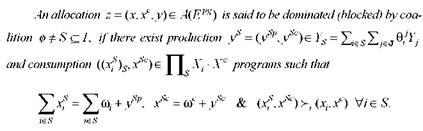
The set of all allocations that are dominated by no coalition is denoted as C(Epg) and is called Foley core.
Foley has introduced this concept [Foley, 1970] and proved under certain assumptions that Lindahl equilibrium belongs to the core. However, does the Foley core shrink to equilibrium under infinity replication of the model? It is well-known from the literature that an infinite replication of the model does not imply that Foley core shrinks to Lindahl equilibria - unlike economies with only private goods. The appropriate examples one can find e.g. in [Muench, 1972]. So, how perfect compe-
[1]Here A denotes the closure of A and∖is set for the set-theoretical difference. This presents local non-satiation of agents' preferences.
tition has to be presented in public goods economy? There are at least two approaches: fuzzy core and contractual approach.
Below I introduce and study the concept of fuzzy contractual allocations for a model with public goods[7] that presents an adequate solution of how can core shrink to Lindahl equilibrium.
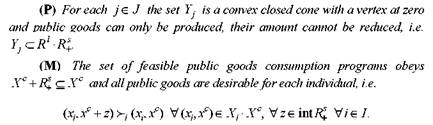
In [Marakulin, 2011] it was proven for exchange economies (under some assumptions) that fuzzy (and properly) contractual allocations are exactly equilibrium ones. Further I will adapt this concept and present results to the economy with public goods.
The main thing, that is necessary to clarify, is what and how is contract concluded in the production sector and how is it broken. The essential feature of these contracts is that they are carrying out a joint production of collective consumption goods. Formally, the contract is

It is formed by the agents which are involved to realize the production program  The break of production contract
 is possible by
any of its members from and it means that all
mutual obligations among members of the coalition S(w) are void.
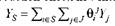
Similarly to barter, production contracts may form a web, i.e. a finite set W of contracts, each subset of which forms a set of agreements, which corre
spond to a feasible production plan: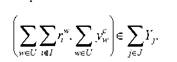
Thus, the specific feature of production webs is that the break of a part of contracts does not directly effect on the implementation of other contracts and the corresponding production programs. Note that forming a joint web with a family V of
7
barter contracts one needs also to require a feasibility in consumption:

Admitting only the total break of contracts we arrive at the concept of contractual allocation. A simple analysis of the definitions shows that the contractual allocations of this type in an economy with public goods are exactly the allocations of Foley core. Indeed, a coalition dominates (blocks) the current allocation
⇔the coalition breaks all contracts and signs new inter-coalitional contracts (both barter and production ones), in which only members of the coalition and their technological set are involved. As a result of these activities,
each member of the coalition should improve upon its position (get higher utility). Finally, the core is the set of feasible allocations implemented by a web of contracts that no coalition can improve upon. Allowing the possibility to break contracts partially one leads to a more qualified type of stability...
It was shown in previous studies that contractual approach and especially its methodology related to the partial breaking of contracts may be considered as a specific way to model perfect competition conditions. Being much simpler than the well- known in the literature «classical» methods (nonatomic space of economic agents by Aumann, or replicas and Edgeworth equilibria by Debreu - Scarf and Aliprantis, etc.), contractual approach leads to the same conclusions as in the previously analyzed situations. It is also applicable to many other situations which are not yet explored. Below I introduce the concept of fuzzy contractual allocation, which really can be considered as an alternative model of perfect competition.
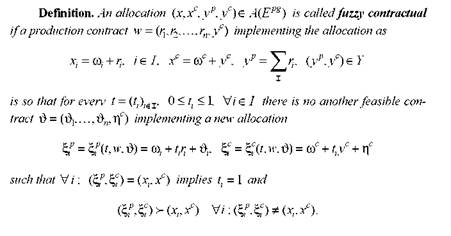
Imagine that at some intermediate moment of economic interaction, individuals intend to improve the structure of their contracts, partially breaking the old ones and entering into new contracts. Nobody controls or coordinates their contractual activities. Therefore, the break of contracts may take place asynchronously and secretly, resulting that in an intermediate planning stage individuals may operate with unrealistic asymmetrical agreements which are not contracts at all. However, during the search of a new contract agents can rely on the resources made through such bogus contractual options. This can motivate them to sign new contracts and really to break old ones,

237but now contractual system as a whole breaks down. Fuzzy contractual allocation is resistant to such perturbations of the contractual agreements. A formalization of this scenario is now presented.
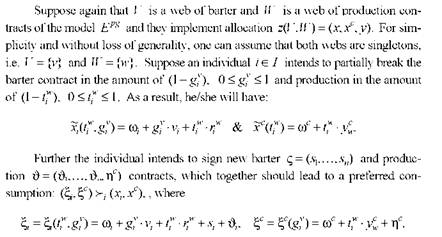
The situation can be further simplified if one notes that due to the definition of barter contract and hence
 was a feasible production contract, i.e.
 is also feasible. Therefore, there is no need to use two new contracts for domination, it is sufficient to apply only one production contract A. Moreover, it will also be valid for the original allocation: if instead of two contracts v and w one considers only a production contract
 then the stability of allocation and the web of
contracts can only be strengthened.
238
Notice that the definition posits the absence of explicit contractual missense activity, leaving consumption bundle unchanged, but non-trivial current contract is broken, and the broken part is then returned to the individual through his/her participation in a new contract. Now I present the most significant facts on fuzzy contractual allocation.
Proposition. Let Epgobey (P), (M). Then Lindahl equilibrium is a fuzzy contractual allocation.
Lemma. An allocation is fuzzy contractual if and
only if it is (lower) stable relative to the partial breaking of contracts and
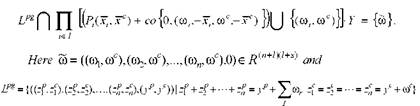
is the subspace corresponding to the balance constraints of economy with public soods.
The central result of the paper is the following theorem on the equivalence of Lindahl equilibria and fuzzy contractual allocations proven via lemma char.

fuzzy contractual if and only if it is a Lindahl equilibrium allocation.
Notice that for irreducible economies it is true without interior point assumption.
Conclusion
Contractual approach for an economic model with public goods and convex production was proposed and analyzed in the paper. The study presents contractual description of important theoretical concept of Lindahl equilibrium which is characterized in cooperative terms. The main result is a theorem on the equivalence of Lindahl equilibria and fuzzy contractual allocations. The theorem characterizes Lindahl equilibrium do not involving the individual prices apparatus which is difficult to implement in practice; here, using an appropriate concept of contract, purely cooperative properties of the economic model are embodied into the results. It does not appeal such notions as congested public goods and crowing in its provision. Howe-
ver presented result can be applied only for public goods that can be provided by production contracts admitting partial break.
References
Florenzano M., Mercato E.L. Edgeworth and Lindahl - Foley Equilibria of a General Equilibrium Model with Private Provision of Pure Public Goods // Journal of Public Economic Theory. 2006. 8. Р. 713-740.
Foley D.K. Lindahl's Solution and the Core of an Economy with Public Goods // Econometrica. 1970. 38. Р. 66-72.
Kozyrev A.N. The Stable Systems of Contracts in an Exchange Economy // Optimization. 1981. 29(44). Р. 66-78 (Institute of mathematics SB AS USSR, in Russian.)
Makarov V.L. Economic Equilibrium: The Existence and Extremal Properties // Sovremennye problemy matematiki. Itogi nauki i tehniki. 1982. 19. Р. 23-58. (in Russian.)
Marakulin V.M. Contracts and Domination in Incomplete Markets. Economic Education and Research Consortium. Working Paper Series 2003. № 02/04. (www.math.nsc.ru/ ~mathecon/marakulinENG/CONTRACTSeng.pdf)
Marakulin V.M. Contracts and Domination in Competitive Economies // New Economic Association Journal. 2011. 9.Р. 10-32. (in Russian.)
Milleron J-C. Theory of Value with Public Goods: A Survey Article // Journal of Economic Theory. 1972. 5. Р. 419-477.
Muench T. The Core and Lindahl Equilibrium of an Economy with a Public Good // Journal of Economic Theory. 1972. 4. Р. 241-255.
Polterovich V.M. Mathematical Models of Resources Allocations. M.: Central Economic-Mathematical Institute, 1970. (in Russian.)
Roberts D. A Note on Returns to Group Size and the Core with Public Goods // Journal of Economic Theory. 1974. 9. Р. 350-356.
Ruys P.H.M. Public Goods and Decentralization. Tilburg, The Netherland: Tilburg University Press, 1974.
Vasil'ev V.A., Weber S., Wiesmeth H. Core Equivalence with Congested Public Goods // Economic Theory. 1995. 6. Р. 373-387.
Weber S., Wiesmeth H. The Equivalence of the Core and Cost Share Equilibria in an Economy with Public Goods // Journal of Economic Theory. 1991. 54. Р. 180-197.
Еще по теме ON EDGEWORTH CONJECTURE AND CONTRACTUAL ECONOMIES WITH PUBLIC GOODS[4]:
- Социальное партнерство и корпоративные социальные коммуникации: PR как Public Relations и Public Responsibility
- Durable goods orders
- DURABLE GOODS ORDERS
- ^ Эджуорт L.i Фрэнсис Исидор Edgeworth Francis Ysidro о (1845 — 1926)
- Приложение 2. ПРОФЕССИОНАЛЬНЫЕ КОДЕКСЫ PUBLIC RELATIONS
- Public sector borrowing requirement (PSBR)
- 3.1. Політичні комунікації та Public relations: досвід України
- IPO или Initial Public Offering (Первичное публичное размещение)
- Приложение 7. Программа курса «Public Relations» Тематический план и программа курса, вопросы к экзамену и литература
- THE ROADS WE TAKE AND GOVERNMENTS WE ELECT: EVIDENCE FROM THE USA
- БИБЛИОГРАФИЯ
- Українсько – англійській словник термінів
- Глава 2. Общие особенности экономики и менеджмента некоммерческих организаций.
- ENTREPRENEURSHIP IN THE INFORMAL SECTOR DURING TRANSITION: CAUSES, SPECIFIC FEATURES, SOCIO-ECONOMIC EFFECTS
- ЛИТЕРАТУРА 1.
- КАЧЕСТВО И ИНФОРМАЦИЯ
- ЛИТЕРАТУРА 1.
- 6.4. Приложения кооперативных игр
- Методы государственного регулирования рыночной экономики
- Список литературы